
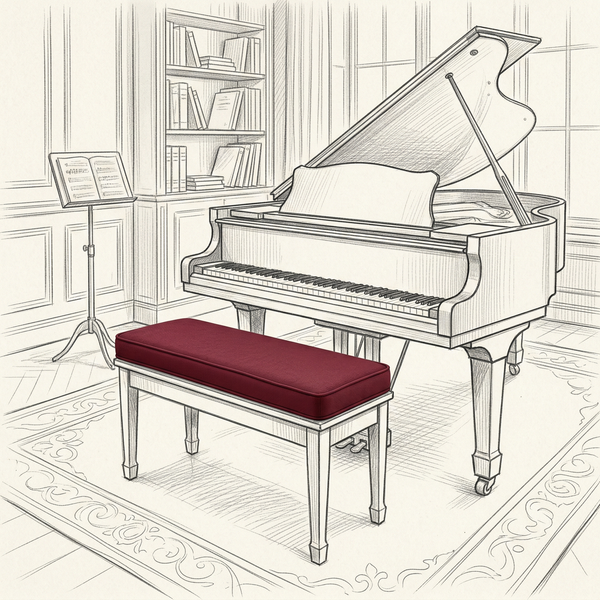
Slim 1–2" profile
Thin enough to keep your wrists at the right keyboard height — the way the bench was originally designed.
MUSICIAN'S ATELIER
1- to 2-inch firm fill for posture, non-slip backing, optional ties — made for upright, grand and roll-style benches.

THE COLLECTION
Slim, firm, properly proportioned for the music room.
WHY FOAMERA AT THE PIANO
A piano bench is a precision instrument. The cushion shouldn't fight it.
Thin enough to keep your wrists at the right keyboard height — the way the bench was originally designed.
High-density foam holds you up, not down — essential for hour-long practice sessions and good technique.
Rubberised underside grips polished bench tops — the cushion stays where you sit it, no chasing it forward.
Patterned to your bench — duet, single, roll-top, lift-lid — with the ends squared or eased to your preference.
Five careful steps from your bench to a slim, fitted cushion.
Browse 22 shapes or send a sketch — round, L-shape, custom corners, anything.
Use our live configurator or a video call. We'll guide you to the quarter inch.
1,000+ fabrics — linen, velvet and boucle. Free swatches at your door.
Piping, ties, zippers, fill type. Fine-tune until it's exactly right.
Made in our atelier in 10–18 business days. Tracked worldwide delivery.
GOOD QUESTIONS
The questions teachers, players and parents ask us most.
The most common bench sizes we make for are roughly 30 × 14 inches (single bench), 36 × 14 (slightly extended), and the wider 42 to 48 × 14 duet benches. Roll-top and lift-lid benches sit in similar widths but with eased corners. There's no real industry standard, though, so always measure your bench top end-to-end and front-to-back rather than assuming a category. Tell us the bench make if you know it and we can usually confirm against our pattern files.
For a piano bench, thinner is correct. One inch is our recommendation for serious players — it adds comfort without raising your seat height enough to throw off keyboard ergonomics. Two inches is the upper limit and feels noticeably plusher; we'd only go thicker if your bench sits unusually low for you to begin with. Anything beyond two inches and the bench's relationship to the keys breaks down. Trust the maker who built the piano on this one.
Two layers of defence. First, our optional non-slip backing — a thin rubberised layer on the underside that grips polished wood without scratching it. Second, optional fabric ties at the back two corners, which loop around the bench legs or the back rail of a roll-top bench. For most upright benches, ties alone are enough. For grand piano benches with no rails, the non-slip backing is the better answer. Pick one or both in the configurator.
Yes — and they look beautiful on a traditional roll-top bench. Diamond-tuft and biscuit-tuft both suit piano cushions; we'd suggest fewer, larger tufts on a slim cushion (otherwise the buttons sit on top of each other). Self-fabric buttons read formal; contrast leather buttons read modern. Tufting is selectable in the configurator's extras step. It adds a few days to production.
Yes — piano stools, organ stools, harp stools, all variations on the round/oval theme. Measure the diameter (or major and minor axes for an oval) of the seat top, decide whether you want the cushion flush with the wood edge or proud by half an inch, and we'll cut and cover accordingly. Round stool cushions take piping beautifully; we'd suggest considering a contrast colour to define the edge.
The classical answer is a deep solid colour close to the wood tone — burgundy or oxblood for rosewood, forest or hunter green for walnut, navy or charcoal for ebony. The contemporary answer is to skip matching entirely and use a fabric that contrasts the cabinet — soft cream against a dark grand, dusty rose against a Steinway. Order three or four free swatches, lay them on the closed lid, and trust your eye. Browse the library to start.
Yes — pianos belong indoors and our piano bench cushions assume the same. We use indoor easy-clean fabrics (linen blends, velvets, Aquaclean weaves) and standard high-density foam, which doesn't tolerate damp. If you have an unusual situation — say, a covered conservatory piano — message the atelier and we can discuss a hybrid build with outdoor fabric over standard foam.
STILL DECIDING?
Send measurements, photos or a sketch — we will reply within a working day.